How to Stop Impulse Buying Clothes on Sale

Sales don't make us buy more clothes. They make us buy faster.
That's why wardrobes often get fuller after every sale, while the feeling of "I have nothing to wear" never really goes away.
Summer sales, Black Friday or end-of-season markdowns — the pattern is always the same.
The short version: before you buy, take a photo of the piece, add it to your digital wardrobe, and try to build at least three outfits with what you already own. If it slots in easily, that's a good buy. If suddenly you need a new dress, new shoes, and a new bag to go with it — the discount was more convincing than the item itself.
That single habit is what turns most impulse purchases into real, well-used clothes.
The bag that almost bought itself
You know the feeling. Your wardrobe is missing something — an accessory, maybe. And there it is. The bag. Beautifully lit. A −50% sign right next to it. It feels like this piece is finally going to pull all your outfits together. Your hand is already reaching for your wallet.
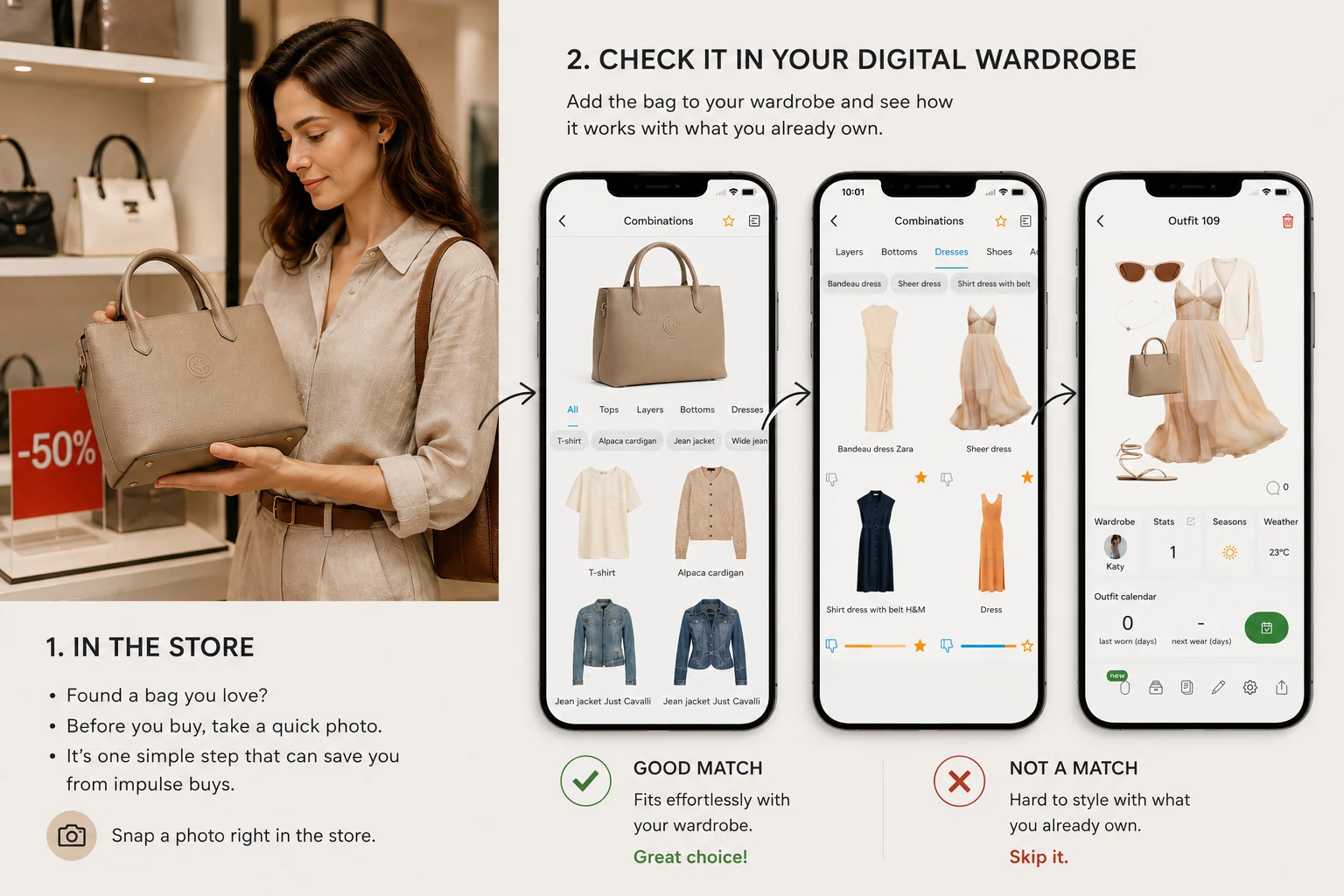
Pause. Take one small step. Photograph it. Right there, in the store.
Drop the photo into your digital wardrobe — the background is removed automatically — and look at the bag next to your actual clothes.
Sometimes it clicks instantly. There's the linen dress. The white shirt. Your favourite sandals. Suddenly you've built the exact summer outfit you were missing.
And sometimes the screen tells you the truth. The bag is beautiful. It just doesn't have any friends in your wardrobe.
That's when it turns out you weren't buying the bag. You were buying a feeling.
It happens to almost everyone. Very few people regret a purchase while they're still in the store. The regret usually comes weeks later, when the piece is still hanging in the wardrobe because nothing really goes with it. That's why the best time to decide is before you pay, not after.
Why it feels like you have "nothing to wear"
Impulse purchases rarely happen because you're actually short on clothes. The reason is usually much simpler. You can't see the wardrobe you already own.
The store looks perfect. Everything hung neatly. Colours coordinated. New arrivals up front. Meanwhile your own wardrobe only exists in memory — and memory lies to you regularly.
According to WRAP — a UK non-profit that studies consumer behaviour and sustainable use of resources — the average UK adult owns 118 items of clothing, and one in four hasn't been worn in over a year. The most forgotten pieces? Dresses and skirts.
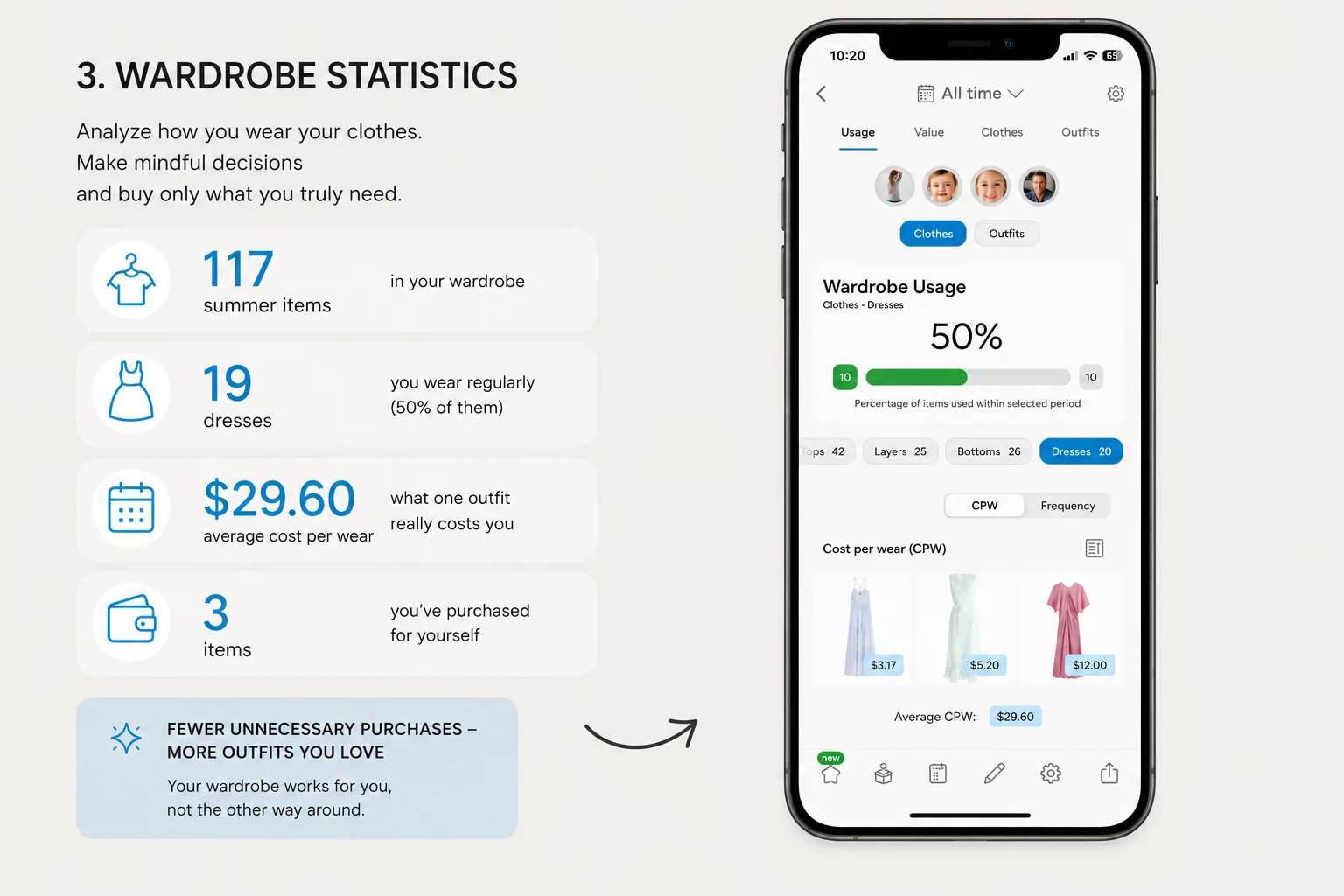
We see the same thing in real GetWardrobe wardrobes. One user turned on the "Summer" filter and discovered she owned 117 summer pieces. Another realised she already had 19 dresses — while the sale dress she was about to buy felt like the one she was "missing".
The problem isn't the number of clothes. It's that you've stopped seeing them.
Why your hand still reaches for the checkout
This is the psychology of impulse buying.
If it were purely about willpower, sales would have stopped working years ago. But 84% of shoppers admit to impulse buying. Your brain works against you.
First — dopamine. The strongest hit of pleasure doesn't come after the purchase. It comes during anticipation. That's why an item feels indispensable in the store and completely ordinary by the time you're home.
Second — manufactured scarcity. "Only 2 left." "Last day." "70% off." Those aren't properties of the clothing. They're store tools designed to speed up your decision.
Third — the idealised version of yourself. You're not buying the dress for the life you actually live. You're buying it for the version where you go to dinners more often, host picnics, travel, or finally start running in the morning. The discount just helps you close the deal with yourself.
The good news: one simple trick works against all three mechanisms. You need to show yourself the wardrobe you actually have.
Stylists call this shopping your closet — treating your existing clothes as the first store you check.
The three-outfit rule
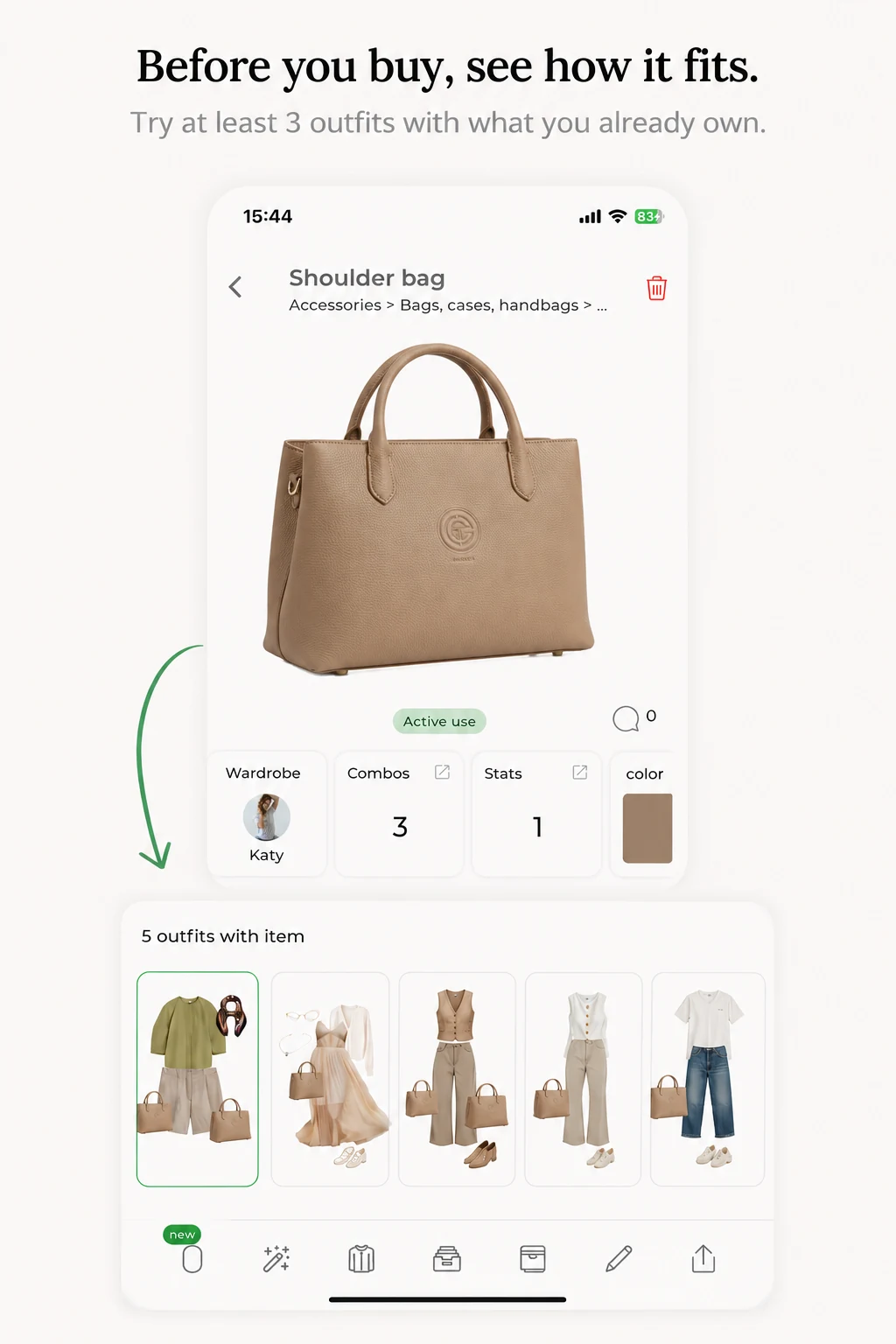
The easiest way to avoid an impulse purchase is to check how well the new piece plays with what you already own. Ask it three questions before you buy.
"How many outfits can I build with you?" Try to put together at least three different looks — manually or with the AI generator in GetWardrobe. If the piece requires a new bag, new shoes, and another jacket to work, it's not going to be your new favourite. It's the start of a new shopping list.
"Who do you hang out with here?" Look at your wardrobe's colours. A new piece should strengthen the palette you already have, not sit apart from it.
"When am I actually wearing you?" Next week? A work meeting? Your holiday? Or a vague "someday"? If there's no answer, this piece is going straight to the "never worn" pile.
When numbers are more honest than feelings
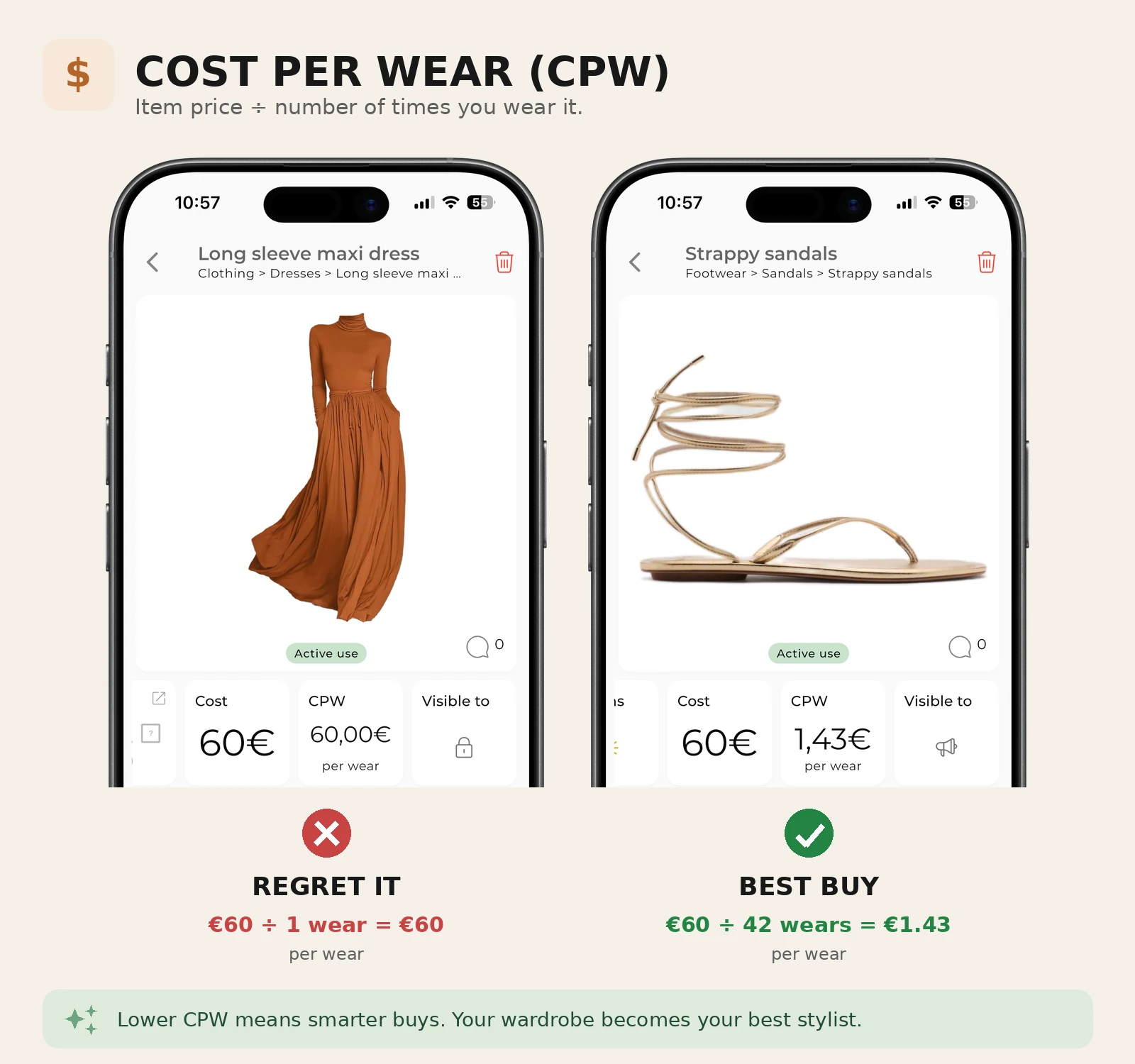
Emotions get it wrong all the time. Numbers rarely do. There's one simple metric: cost per wear. It works exactly the way it sounds — price of the item ÷ the number of times you actually wore it.
A $30 dress you wore once costs $30 per wear. A $60 basic shirt you've worn 30 times costs $2 per wear. The best purchase is often the one with the smallest discount.
That's why the "30 wears" rule exists. Before buying, ask yourself honestly: "Will I actually wear this at least 30 times?" If the answer is yes, you're probably making a good decision.
What to buy on sale
Sales work best when you arrive with a plan.
When you already know what you're looking for, the discount becomes a bonus — not the reason you buy it.
Look for capsule wardrobe staples, such as:
- basic T-shirts;
- jeans;
- shoe styles you already love and wear;
- the bag that's been on your list for months;
- replacements for pieces you've genuinely worn out.
Be more careful with:
- ultra-trendy items;
- clothes "for a future life";
- pieces that don't have obvious outfits ready in your wardrobe.
The most useful pre-checkout question: "Would I buy this without the discount?" If the answer is no, it wasn't the item that convinced you — it was the red tag.
Your wardrobe becomes your advisor
When your whole wardrobe lives in one place, shopping gets easier — not because you buy less, but because you buy right.
You immediately see:
- which pieces you actually wear most;
- which categories are overflowing;
- which pieces have already paid for themselves;
- where the real gaps are;
- what one wear of each item is costing you;
- which colours already dominate your wardrobe.
Sometimes the stats are the best stylist you've ever had. They tell you honestly that last summer, you wore eight favourite pieces — and everything else quietly waited its turn.
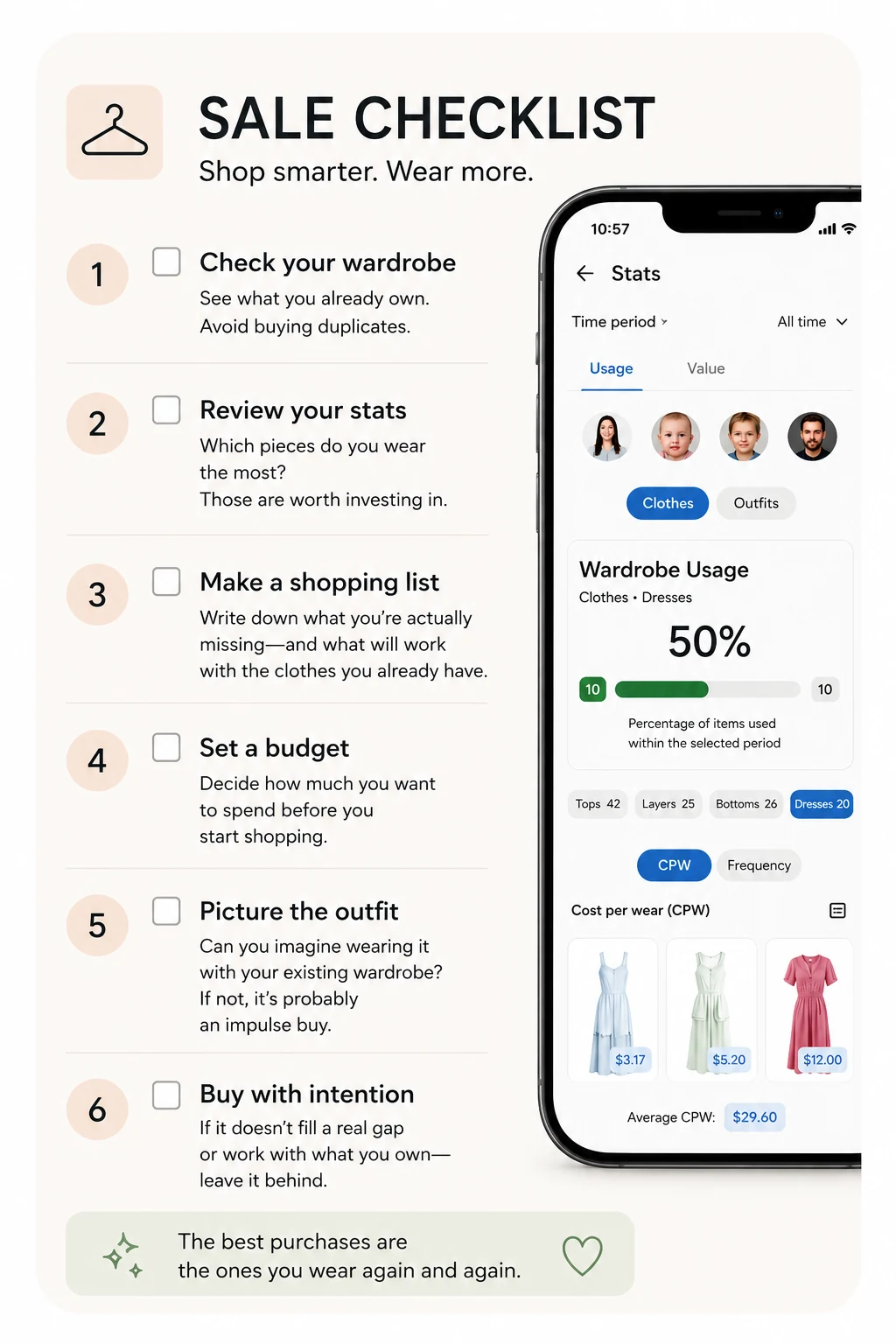
Pre-sale checklist (15 minutes)
Before you open your favourite store, give your wardrobe a few minutes first.
- Look at your wardrobe structure by category.
- Check the most-worn section.
- Check the pieces you've never actually worn.
- Write down 5–7 items you genuinely need. Split them into two lists:
- Need now — you're actively struggling without it.
- Can wait — you'd like to buy it, but you can live without it for now.
- Set category limits. For example: "I already have enough dresses — one new one max."
Now the sale stops dictating your shopping. You're using the sale to close real gaps in your wardrobe.
How GetWardrobe helps you shop mindfully
GetWardrobe helps you see your wardrobe for what it actually is.
With the app, you can:
- digitize your wardrobe in 15 minutes a day;
- try new potential purchases against your existing pieces before you pay;
- see which items you wear most;
- calculate cost per wear;
- see the real colour palette of your wardrobe and build your basics;
- spot gaps and duplicates;
- get fresh outfit combinations with the AI generator or AI Studio;
- plan outfits ahead and pack for trips.
Once your clothes stop being "somewhere in the closet" and start being visible, shopping mindfully becomes a lot easier.
FAQ
Why do I keep buying clothes I never wear? It's usually not about the amount of clothing you own — it's that you can't see your whole wardrobe at once. A new piece feels essential in the store, even though you already have several similar things at home.
How do I stop impulse buying clothes on sale? Make a list of what you actually need before the sale starts, take a photo of anything you're tempted by in-store, and try to build at least three outfits with it from your existing wardrobe.
What should I buy on sale first? Basics, replacements for the pieces you wear the most, and items that have been on your list for a while — not brand-new trends.
How do I know if I really need this item? If it works with at least three pieces you already own, fills a genuine gap in your wardrobe, and you already know when you'll wear it, it's probably a good purchase.
What is cost per wear? The price of an item divided by the number of times you actually wear it. It's the honest metric for whether a purchase was a good decision.
What is the three-outfit rule? Before buying, try to build at least three outfits with the new piece, using clothes you already own. If it doesn't work, the piece probably won't become a wardrobe staple.
Should I do a no-buy year? It works for some people, but strict bans often collapse at the first sale. A gentler approach: see your whole wardrobe first, then buy only what genuinely rounds it out. And if you're already doing a no-buy or low-buy year, wear stats turn it from a struggle into a game.
Where do I start if my wardrobe isn't digitized yet? Start with what you're wearing right now: photograph the pieces you have on today and add the ones you're planning to wear tomorrow. Then add a handful more each day. Within a week you'll have a live, working wardrobe. Full walkthrough in How to digitize your wardrobe.
The best purchase isn't the one with the biggest discount. It's the one you'll still be wearing next summer.
Need help?
Contact us at support@getwardrobe.com