Style, context, and real life: dressing for the situation
This is part of the guide How to Put Together Outfits — a closer look at the third group of principles: style, context, and real life.
Appropriateness
How it works. The same outfit can look great in one situation and out of place in another. So it's worth considering not just your own style but the occasion itself: where you're going, what kind of event it is, and how formally people dress there.
Dress codes can loosely be arranged by formality — from casual and smart casual up to business formal, cocktail, black tie, and white tie. But it isn't a strict ladder: workwear and evening wear live in different contexts, so it's not only the level of formality that matters but the event itself.
Where it comes from. Modern dress codes took shape gradually. In the late 19th century, clearer rules for evening wear emerged: the dinner jacket appeared as a less formal alternative to the tailcoat, and the distinction between black tie and white tie settled in later.
Black tie and white tie
Black tie is a formal evening dress code built around a tuxedo and long evening gowns; white tie is even more formal and strict, tied to the tailcoat and to balls and state occasions.
Office wear, by contrast, grew less strict over time. Aloha Friday in Hawaii, and then the American casual Friday, helped normalize a more relaxed office style, and today's versions of business casual grew out of that culture.
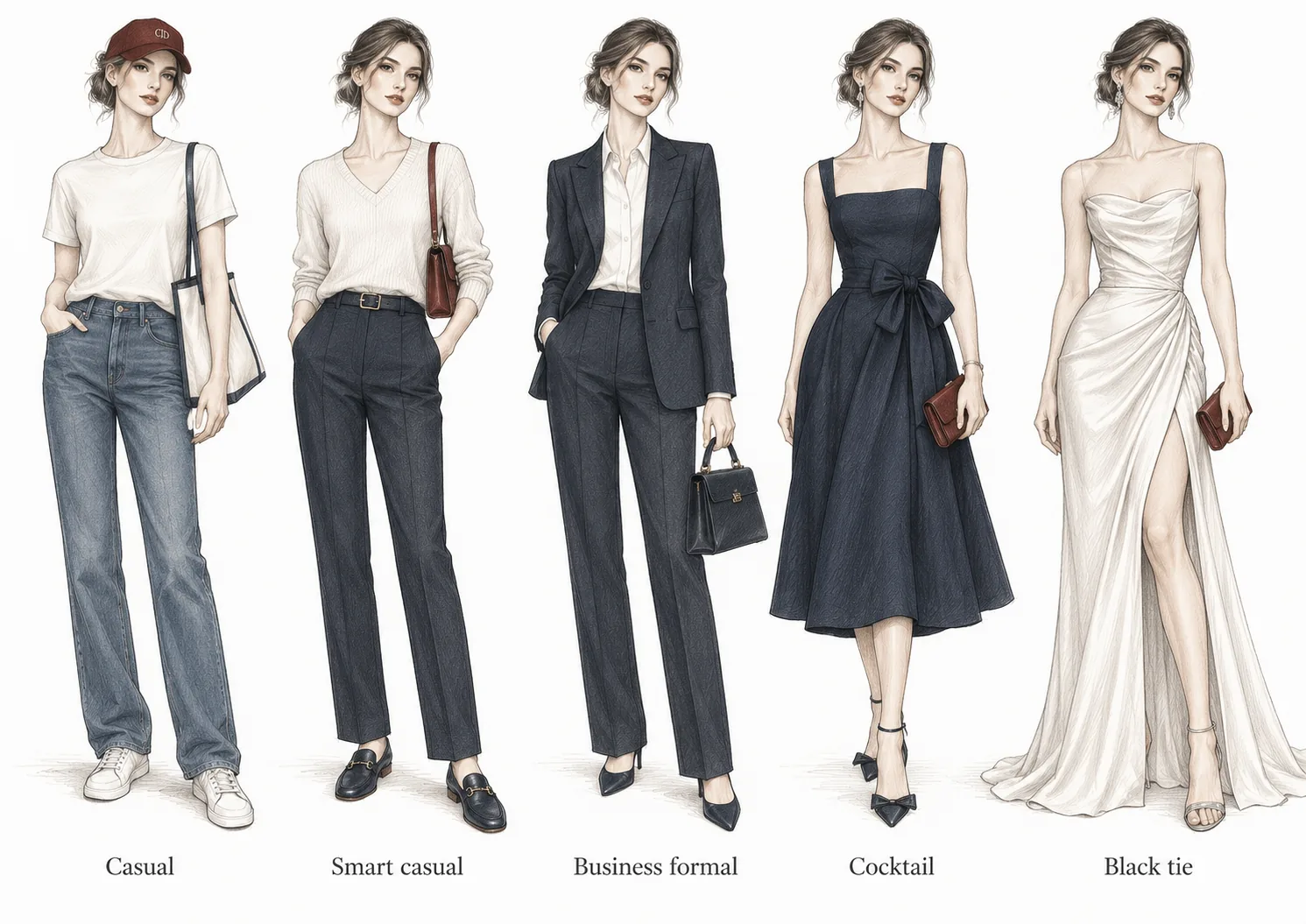
Who it's for. Anyone who runs into explicit or unspoken expectations about clothing: at work, in interviews, at weddings, celebrations, and other events. A dress code helps you get the general direction and avoid ending up noticeably more or less dressed up than the situation calls for.
Strengths and limits. A formality scale is handy as a guide, but its boundaries depend heavily on the country, the company, and the specific event. Smart casual and business casual are especially fuzzy: the same label can mean very different clothes in different places.
Formality also isn't created by a single piece but by the whole outfit — silhouette, materials, shoes, accessories, and details.
In practice. If a dress code is stated, check the host's notes or examples for that specific event. If the wording is vague, it's often sensible to go a touch dressier than expected, without jumping into an entirely different format.
It also helps to have a few tried-and-true outfits for the situations you face most often — one for smart casual, one for a work setting, and one for an evening out.
Outfit formulas and a personal uniform
How it works. An outfit formula is a template of roles you can drop different pieces into. The formula jeans + tee + jacket stays the same even when the cut of the jeans, the color of the tee, the fabric of the jacket, or the shoes change.
For example:
- jeans + tee + jacket + loafers;
- wide trousers + a compact knit + a second layer + sneakers;
- a dress + a second layer + boots;
- a midi skirt + a sweater + flats;
- tailored trousers + a fine knit + loafers + a structured bag;
- a turtleneck + wool trousers + a coat.
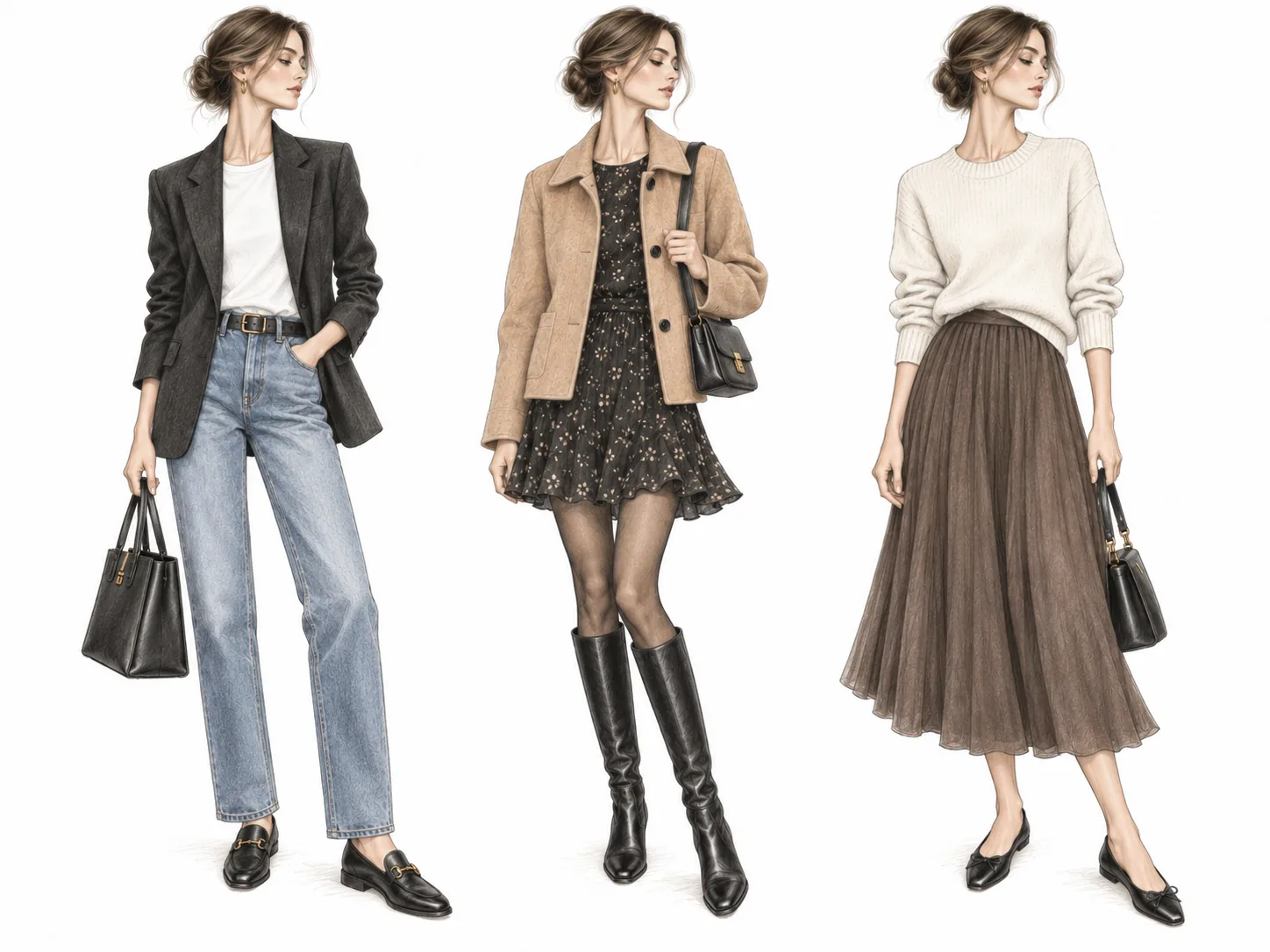
A formula describes not specific pieces but their roles in the outfit — and each role can exist in dozens of variations.
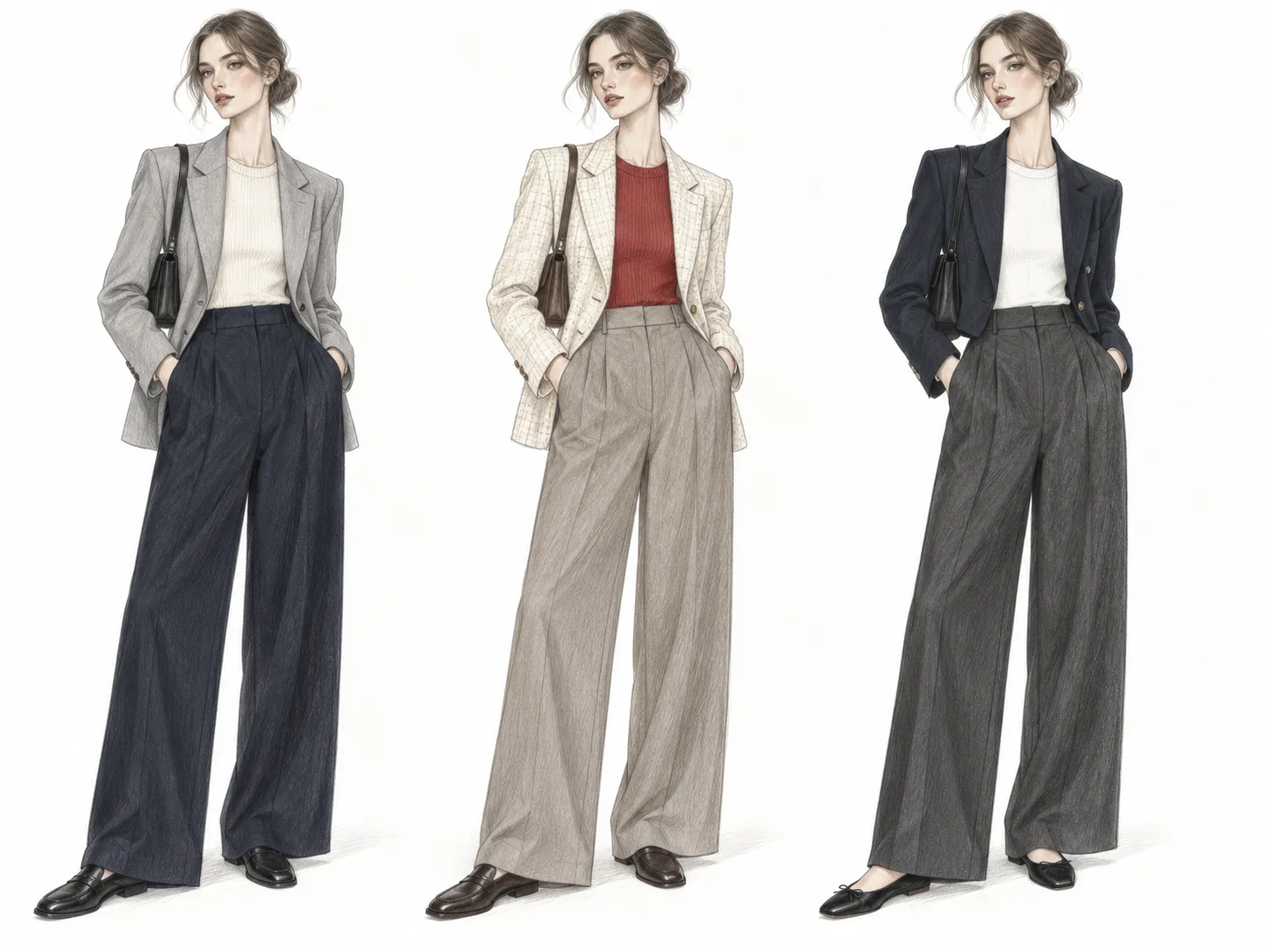
A personal uniform is a narrower approach. You deliberately pick one or two proven formulas and build most of your everyday wardrobe around them — for example, a dark bottom + a solid top + white sneakers. The specific pieces can change, but the scheme stays familiar. It cuts down the number of decisions on an ordinary day, and it doesn't mean wearing the exact same outfit every time.
Where it comes from. This approach was systematized in particular by Anuschka Rees in The Curated Closet: she suggests analyzing what you actually wear, spotting recurring silhouettes and combinations, drawing your own formulas from them, and using those as a guide when choosing new pieces.
Who it's for. Especially useful if you often don't know what to wear in the morning, want to get ready faster, or prefer a small, considered wardrobe. Formulas cut down decisions and help you see which combinations actually work in everyday life.
Strengths and limits. Recurring formulas save time, make your style more recognizable, and help reduce impulse buys: it's easier to tell whether a new piece fits combinations that already work.
But relying on a single scheme can make a wardrobe monotonous. A formula works best when it accounts for your proportions, habits, and lifestyle, so someone else's ready-made template isn't always worth copying literally.
In practice. Pick three good outfits you actually wore and felt good in. Break each one down not by specific pieces but by roles — for example, wide bottom + compact top + structured layer + flat shoes.
If the same structure keeps coming up, it's already a candidate for your formula. Put together two or three such templates and swap pieces, colors, and textures within them. That way a formula cuts down decisions without turning your wardrobe into a set of identical outfits.
Styles and internet aesthetics
How it works. A style is a relatively stable visual language. It comes not from a single piece but from recurring combinations of silhouettes, colors, materials, prints, shoes, and details.
Minimalism, for instance, is usually built on clean lines and a restrained palette; romantic style on soft silhouettes and delicate details; preppy on neat knitwear, shirts, and collegiate references; grunge on relaxed silhouettes, denim, flannel, and deliberate scruffiness.
An internet aesthetic works much the same way, but it's usually narrower, more specific, and faster-changing. Names like cottagecore, dark academia, gorpcore, or quiet luxury pull together a recognizable set of pieces, colors, textures, and cultural associations.
The line between a style and an aesthetic isn't always sharp. Internet aesthetics often don't invent an entirely new way of dressing — they gather existing fashion elements into a new combination, give it a name, and spread it through images, moodboards, and social media.
Established styles
- Classic — clean cuts, suiting fabrics, restrained details.
- Casual — denim, knits, simple silhouettes, and comfortable shoes.
- Minimalist — clean lines, a limited palette, minimal decoration.
- Romantic — soft silhouettes, draping, floral motifs, and delicate details.
- Boho — loose silhouettes, layers, natural textures, and crafted motifs.
- Preppy — shirts, knits, pleats, loafers, and collegiate references.
- Streetwear — loose silhouettes, hoodies, tees, graphics, and sneakers.
- Grunge — flannel, denim, leather, distressing, and relaxed scruffiness.
- Utility / workwear — functional cuts, sturdy fabrics, pockets, and work and military references.
- Glam — shine, expressive silhouettes, statement accessories, and a focus on impact.
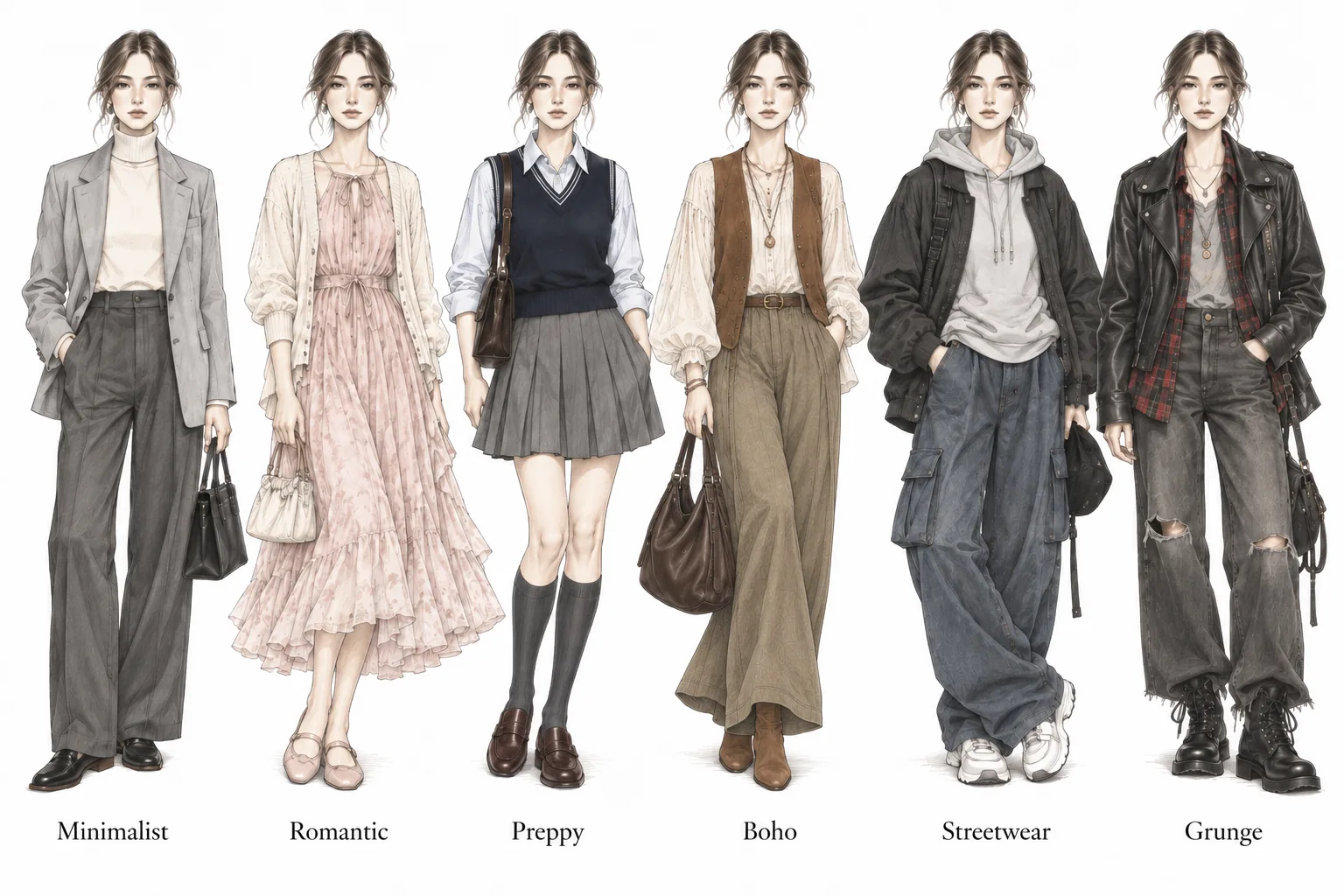
You could add athleisure, eclectic, and other directions to the list. It isn't a closed classification: styles overlap, and one wardrobe can easily combine several of them.
Internet aesthetics
- Cottagecore — a romanticized rural life, floral dresses, knitting, and natural materials.
- Dark academia — a deep palette, tweed, knits, and associations with old universities and libraries.
- Y2K — the aesthetic of the late 1990s and early 2000s: low rise, shine, body-hugging pieces, and metallics.
- Coquette — bows, lace, pastels, and pointedly romantic details.
- Coastal — a light palette, linen, cotton, and relaxed silhouettes with seaside associations.
- Gorpcore — hiking and outdoor gear carried into a city wardrobe.
- Clean girl — neutral colors, simple silhouettes, minimal detail, and a groomed look.
- Normcore — deliberately ordinary, low-key clothing: jeans, tees, fleece, and plain sneakers.
- Quiet luxury — a calm palette, quality materials, clean cuts, and no visible logos.
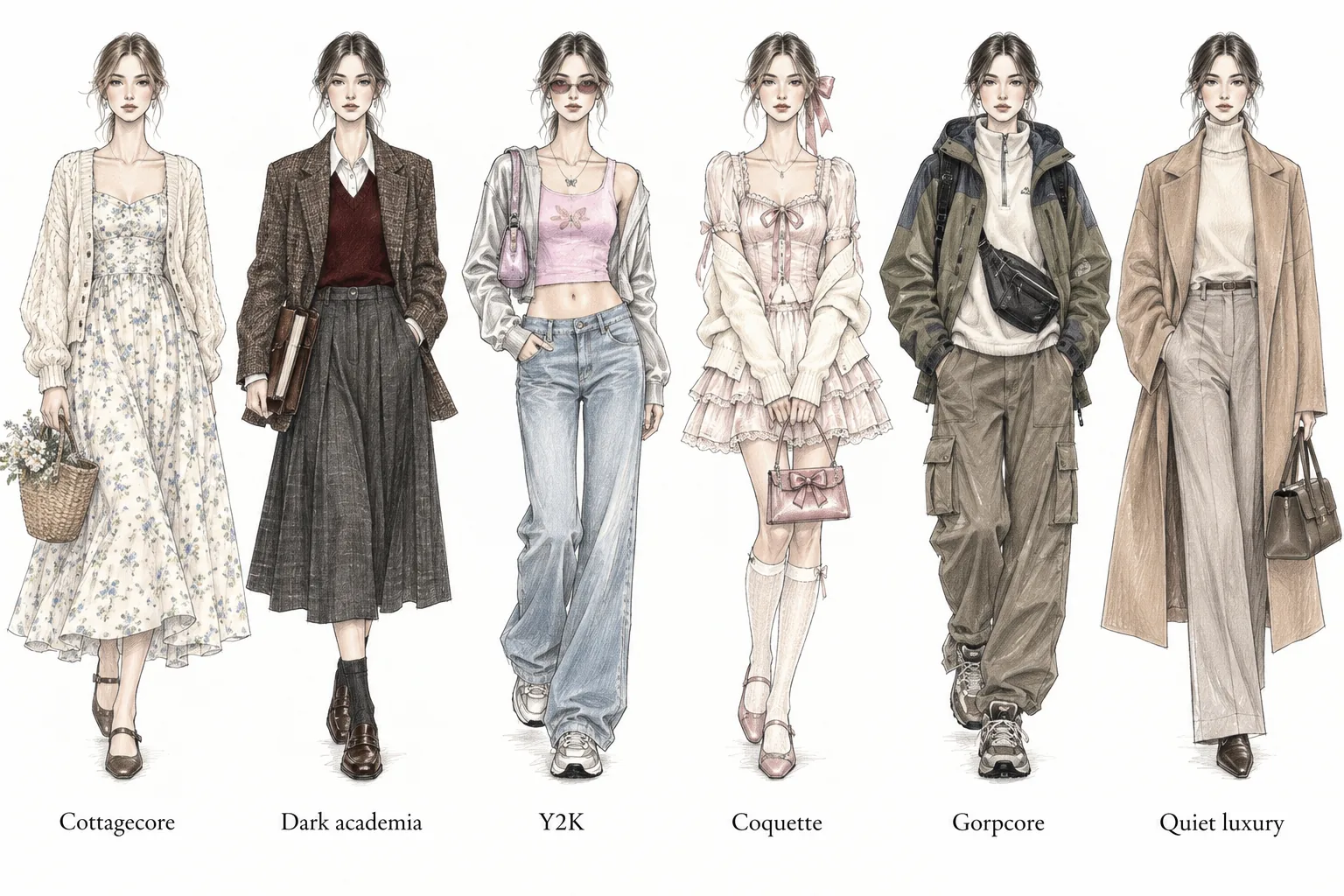
Internet aesthetics change faster than established styles. Some stick around; others last only a few seasons before new names take their place.
Where it comes from. Many styles predate the internet. Preppy grew out of the clothing of American Ivy League students, minimalism developed in fashion over decades, and grunge became a visible part of the fashion language in the early 1990s.
What the internet mainly changed is the speed at which new names and visual systems appear and spread.
Normcore is a good example. The term appeared in the trend group K-Hole's Youth Mode report in 2013. It originally referred not to a specific set of clothes but to the idea of freedom from the constant need to stand out and perform individuality. Fashion media later reframed normcore as a recognizable aesthetic of deliberately ordinary clothing — jeans, tees, fleece, and sneakers.
Cottagecore spread online in the late 2010s and became especially visible in 2020. It combines a romanticized image of rural life with floral dresses, knitting, natural materials, and other visual references to a calmer, more domestic life. The "-core" suffix gradually became a handy way to name new internet aesthetics.
Quiet luxury was discussed especially widely in 2023. But the idea of understated, expensive clothing with no visible logos existed long before. The internet mostly gathered familiar signals into a clear name and made the aesthetic broadly recognizable.
Who it's for. Anyone who wants a more cohesive wardrobe and a better sense of their own visual preferences. A style or aesthetic can offer cues for colors, silhouettes, materials, and details, and so make combining easier.
You don't have to match one direction completely. It's often more natural to pick one main style and add elements of another — a minimalist base with romantic details, a classic wardrobe with a touch of grunge, or preppy with sporty pieces.
Strengths and limits. A style reference helps explain why some pieces combine easily while others sit apart from everything else in your wardrobe. It can also be a useful filter when shopping: a new piece should not only appeal on its own but work with at least a few outfits you already have.
But with internet aesthetics especially, there's a risk of treating a style as a ready-made shopping list. Fast-moving trends can push you to build a new wardrobe for each new name, even when the aesthetic fits your real life poorly.
So it's more useful to treat styles and aesthetics as a source of visual ideas than as a set of required pieces or a new identity.
In practice. Look at the outfits you actually wear and save as references. Notice what recurs: a calm or a high-contrast palette, tailored or relaxed silhouettes, romantic or graphic details, smooth or pronounced textures.
Try to identify one main visual language and, if you like, one secondary one — minimalism + romantic details, classic + grunge, or preppy + sporty pieces.
Before a new purchase, it's more useful to ask not "is this piece aesthetic enough?" but "what in my wardrobe will I wear it with, and does it support the visual language I actually like?"
The three-word method
Stylist Allison Bornstein suggests describing your style in three words — "minimal, relaxed, feminine," say, or "classic, graphic, unexpected."
When putting an outfit together, you can check whether it reflects at least two of those words, whether it strays too far from your real style, and which detail would add the missing quality. The method is especially useful when you like your wardrobe in parts but it feels disconnected as a whole.
Basics, accents, and capsules
One way to make a wardrobe more cohesive is to split pieces into basics and accents.
Basics are the pieces that turn up in outfits regularly and combine easily with the rest of your wardrobe. They don't have to be neutral: for one person the basics are a white shirt and gray trousers; for another, a striped sweater, a burgundy cardigan, or colored trousers.
Accents do a different job — they give an outfit character. That can be a bright color, a print, an unusual texture, expressive shoes, jewelry, or a bag. And the same piece can be an accent for one person and part of the everyday base for another.
The main question isn't "is this a basic by some universal list?" but how easily it fits your wardrobe specifically and how many outfits you can build with it.
For more on how to define your own basics, choose versatile pieces, and avoid copying someone else's "must-have" list, see Basic wardrobe.
A capsule takes the same principle further: a limited set of pieces that work well together. In a separate article on decluttering, we explain in detail how to build a capsule, why there's no fixed number of pieces, and how to test it in practice.
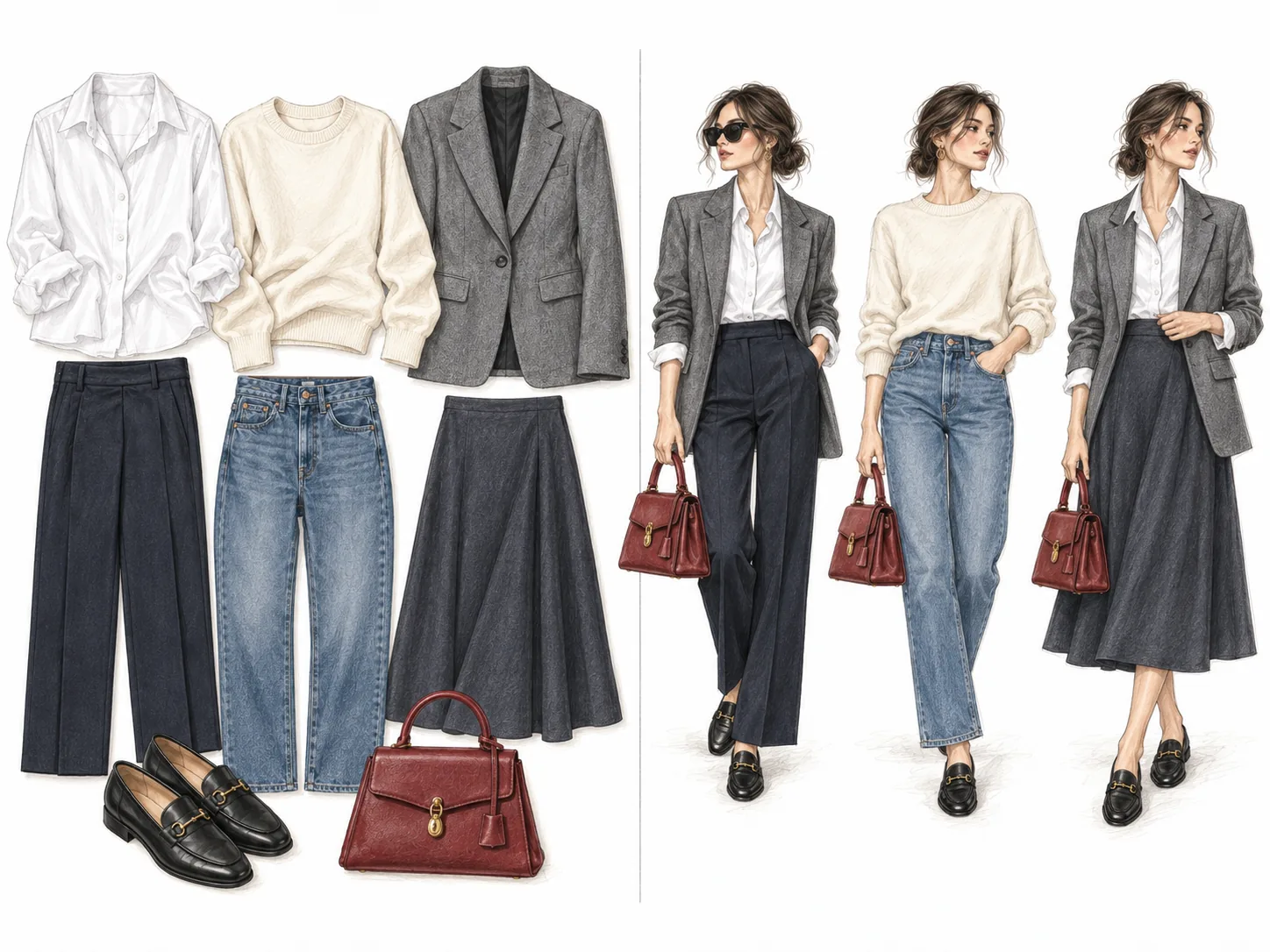
That article also covers Project 333 — the challenge of 33 pieces for 3 months. Its point isn't the number 33, but seeing in practice which pieces you actually use and what your wardrobe is missing.
If you're just starting to review your wardrobe and can't tell whether the problem is the number of pieces, how well they combine, or a mismatch with your lifestyle, it's more useful to start with decluttering: different problems call for different solutions.
Cost per wear
The price of a piece on its own says little about whether the purchase was a good one. A more useful measure is cost per wear: the price divided by the number of times you've worn it.
For example, a €300 coat you've worn 150 times comes to about €2 per wear. A €30 top worn twice is already €15 per wear. So a more expensive piece can sometimes be the better value than a cheap one, if it actually becomes part of your everyday wardrobe.
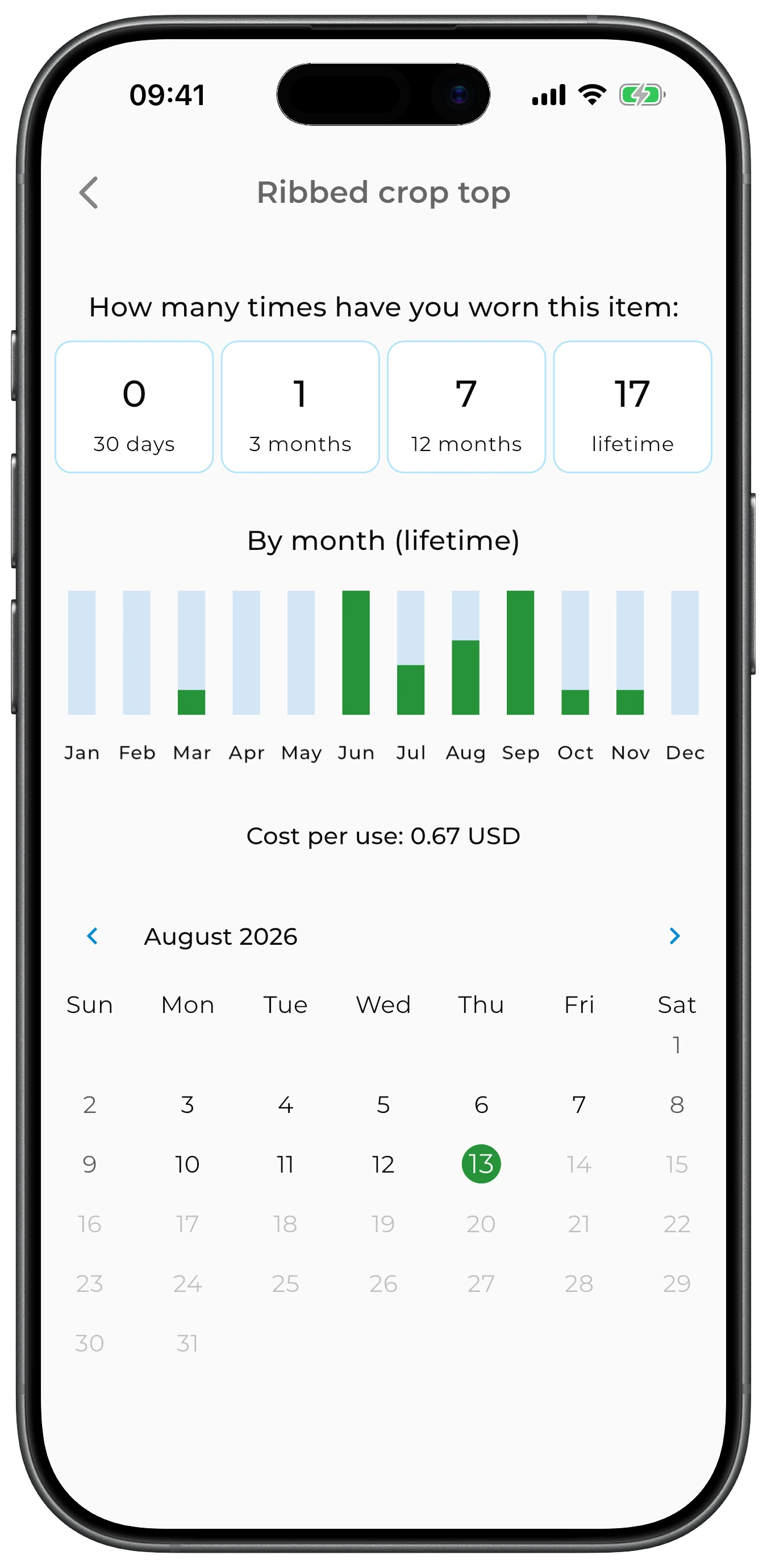
This measure is especially useful for pieces meant for regular use: outerwear, shoes, bags, jeans, trousers, knits, and jackets. For those, it's worth tracking how often the piece actually gets worn. And before buying, you can roughly estimate how often you'll use it and how many outfits you can build with it.
But cost per wear isn't equally useful for every type of item. An evening gown, an outfit for a wedding or another rare event, and some expressive statement pieces may by nature be worn rarely. A high cost per wear doesn't necessarily mean the purchase was a mistake. For those pieces, what matters more is whether you need it for a specific occasion, how well it does its job, and whether you can use it again.
Before buying an everyday piece, you can also use a simpler cue — the 30-wears rule. The #30Wears campaign suggested asking yourself, "Will I wear this at least 30 times?" It's not a required minimum or a test of a "correct" purchase, but a way to pause before an impulse decision and think about how the piece will actually be used.
A trend-driven piece isn't necessarily a bad buy. It's just more likely that interest in it, or the trend itself, won't last. So it helps to think ahead about how the piece fits your existing wardrobe, how many outfits you can build with it, and whether you'll wear it even after the trend stops feeling new.
Mood
Clothing can help you get into the right mindset for a situation: an interview, a presentation, a date, a workday, or time off. We may intuitively reach for more pulled-together, more relaxed, or more noticeable pieces depending on how we want to feel.
In psychology there's the concept of enclothed cognition — the idea that clothing can affect attention, behavior, and how we feel. But research in this area has produced mixed results, and the findings haven't always replicated, so it's not something to treat as a proven, universal effect.
A related popular idea is dopamine dressing — choosing clothes and colors you associate with a good mood. Despite the name, no direct "dopamine" effect from such pieces has been shown.
So rather than leaning on universal formulas like "red makes you more confident," it's better to simply observe yourself. If certain pieces genuinely help you feel calmer, more collected, or more confident, that's already a good reason to wear them more often.
Weather and function
How it works. Sometimes the main principle of a good outfit is very simple: conditions first, aesthetics second. Clothing has to suit not only your style and the situation but the temperature, precipitation, wind, how much you'll move, and how long you'll be outside.
If you'll be walking a lot, think about comfortable shoes in advance. If rain is likely, think about staying dry. If the temperature shifts noticeably through the day, think about layers you can take off or add.
Function isn't the opposite of style. It simply sets the conditions the outfit needs to work within.
The three-layer system. For cold, changeable weather, a system long used in outdoor and sports clothing is useful:
- the base layer sits closest to the body and helps wick moisture;
- the mid layer holds warmth;
- the outer layer protects from wind and precipitation.
In a city wardrobe you don't have to literally use athletic base layers and a waterproof shell. What matters is the principle: a thin layer against the body, insulation over it, and suitable weather protection.
A city outfit, for instance, might be a thin turtleneck, a wool cardigan, and a trench or a waterproof jacket. If it warms up, one of the layers comes off easily.
From function to aesthetics. Some modern aesthetics actually grew out of functional outdoor clothing. Gorpcore, for example, carries technical jackets, fleece, cargo pants, hiking shoes, and other pieces originally built mainly for practical tasks into a city wardrobe.
But you can use the functional principle in any style — from classic to romantic. What matters is that the pieces suit the real conditions.
In practice. Before building an outfit, it helps to check:
- the temperature in the morning and evening;
- the chance of rain or strong wind;
- how much you'll be walking;
- whether you'll be outside or indoors for most of the day;
- whether you can take off or add a layer as the temperature changes.
A wardrobe that doesn't suit your climate and lifestyle won't work well, no matter how correctly it's put together in theory.
See also: Color in outfits and Proportion and composition. Back to the overview — How to Put Together Outfits.
Need help?
Contact us at support@getwardrobe.com