How to Declutter Your Wardrobe: Find the Method That Fits You
Decluttering your wardrobe doesn't have to mean pulling everything out of your closet and deciding what to throw away. Start by figuring out what isn't working: too many clothes, pieces that don't work well together, a wardrobe built for a different lifestyle, or clothes you simply forget you own. Different problems call for different methods, and this guide helps you pick yours.
After all, you can arrange your shirts by color, buy matching hangers, and fold your sweaters into perfect stacks, and still stand in front of the closet thinking, "I have nothing to wear." A tidy closet and a working wardrobe are two different things.
In short: when you have too much, a clean-out helps; when your clothes don't go together, a capsule does; and when you want to test how much you actually need, there's Project 333. And if the problem is overbuying, decision fatigue, or simply not being able to see your whole wardrobe, there are methods for those too.
Start with the problem, not the method
Open your closet and try to finish one sentence: "Getting dressed would be so much easier if..."
- ...I owned fewer things;
- ...I knew what goes with what;
- ...I remembered everything I own;
- ...more of my clothes fit my actual life;
- ...I stopped buying near-identical pieces;
- ...I had a few ready-made outfits and didn't have to think in the morning.
Your answer already gives you a clue about where to start.
According to WRAP (the Waste and Resources Action Programme, a UK sustainability NGO), about a third of the clothing in an average British household hasn't been worn for at least a year, and the most common reason is that the clothes no longer fit (WRAP, Valuing Our Clothes).
Fit is only one reason clothes drop out of rotation, though. A real wardrobe also holds duplicates, uncomfortable clothes (itchy, too tight, chafing), pieces saved "for some occasion," and clothes that simply have nothing to pair with.
Good organization doesn't start with new storage boxes. It starts with a question: why am I not using what I already own?
The KonMari method: when you have too much
Marie Kondo's method asks you to gather all your clothes in one place, consider each item one by one, and decide what to keep. The core criterion is to keep what "sparks joy" (the official KonMari method).
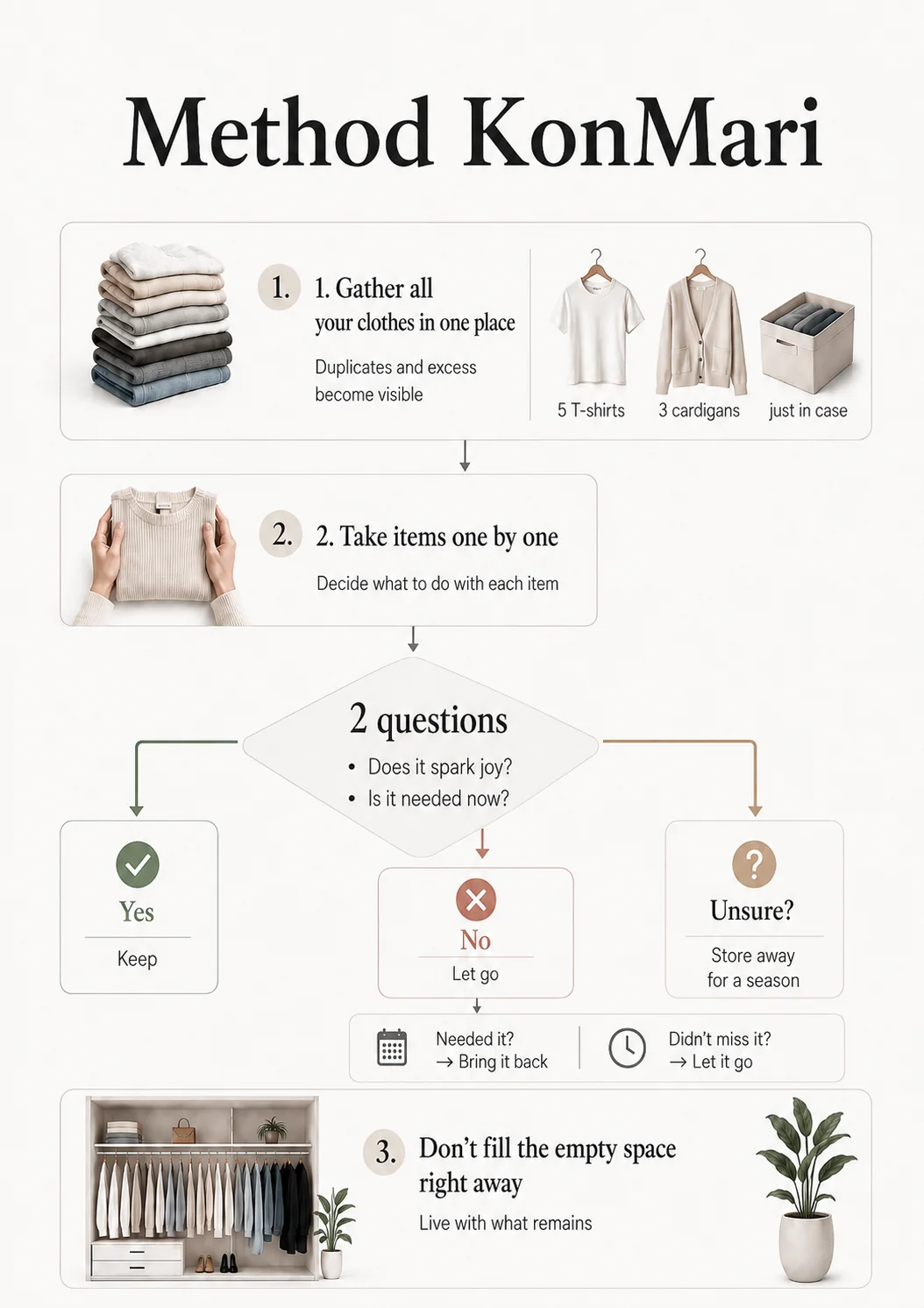
The real power of the approach is that you see all your clothes together for the first time.
Five black T-shirts no longer hide in different drawers. Three nearly identical cardigans end up side by side. The dress that has moved from closet to closet "just in case" finally has to be picked up and dealt with.
The method works especially well on clothes you keep out of guilt: "it was expensive," "it's almost new," "it might come in handy," "I'll wear it again someday."
The joy criterion doesn't fit everything, though. Thermal underwear, work clothes, or a rain jacket may not spark much joy and still be genuinely useful. So it helps to add a second question: "Does this item have a real function in my life today?"
After the clean-out, don't rush to fill the freed-up space. Live with what's left for a while first.
If letting go is hard, quarantine first
You don't have to make final decisions in one day.
Move questionable items out of your main closet space into a box or bin for one season. If you need something, you can always take it back. If a few months pass and you never think of an item, letting go usually becomes much easier.
This works especially well for the "it's nice, but somehow I never wear it" category.
The capsule wardrobe: when your clothes don't go together
People often treat a capsule wardrobe as a challenge: "Can I live with 30 items?"
But the number is not the point.
A capsule is a small set of clothes that work with each other, so a limited number of pieces produces enough outfits you actually want to wear. The modern concept is credited to Susie Faux and was popularized by Donna Karan's Seven Easy Pieces collection (history of the capsule wardrobe).
Popular seasonal versions often use around 30 to 40 pieces, but there is no fixed rule.
Three checks matter far more than any count.
Does every core piece have several partners? If a skirt only works with one blouse, and that blouse only works with that skirt, they add very little versatility to your wardrobe.
Does the set cover your real life? Work, errands, meetups, sport, travel: your capsule should reflect how you actually spend your time, not a universal list of "pieces every woman needs."
Do you actually like the outfits? Items can match perfectly on paper, but if you never feel like wearing the combinations, the capsule exists only in theory.
A good place to start is the clothes that already work. Look at your most-worn items: some of them may be good candidates for the core of your capsule. Then check whether they cover your main occasions and whether they combine into outfits you genuinely want to wear.
Test your capsule with AI
You can build a capsule and see how it works right in the app — before buying or setting anything aside.
- Give the items you want to test their own tag — for example "Autumn capsule 2026" (or something shorter: "Capsule", "Autumn capsule").
- Open the AI Generator or AI Studio and filter by that tag.
- See what outfits the app builds from the selected items.
Are there enough combinations? Are there items the AI barely uses? That's a reason to look at them more closely: is it easy to build a few outfits with them, and do they really belong in this capsule?
If building the capsule suddenly seems to require buying seven more items, stop. A good capsule should unlock the wardrobe you have, not turn into a new shopping list.
Project 333: how much you actually need
If you find it easier to test something in practice than to analyze it for too long, Project 333 by Courtney Carver may suit you.
The rule is simple: 33 items for 3 months.
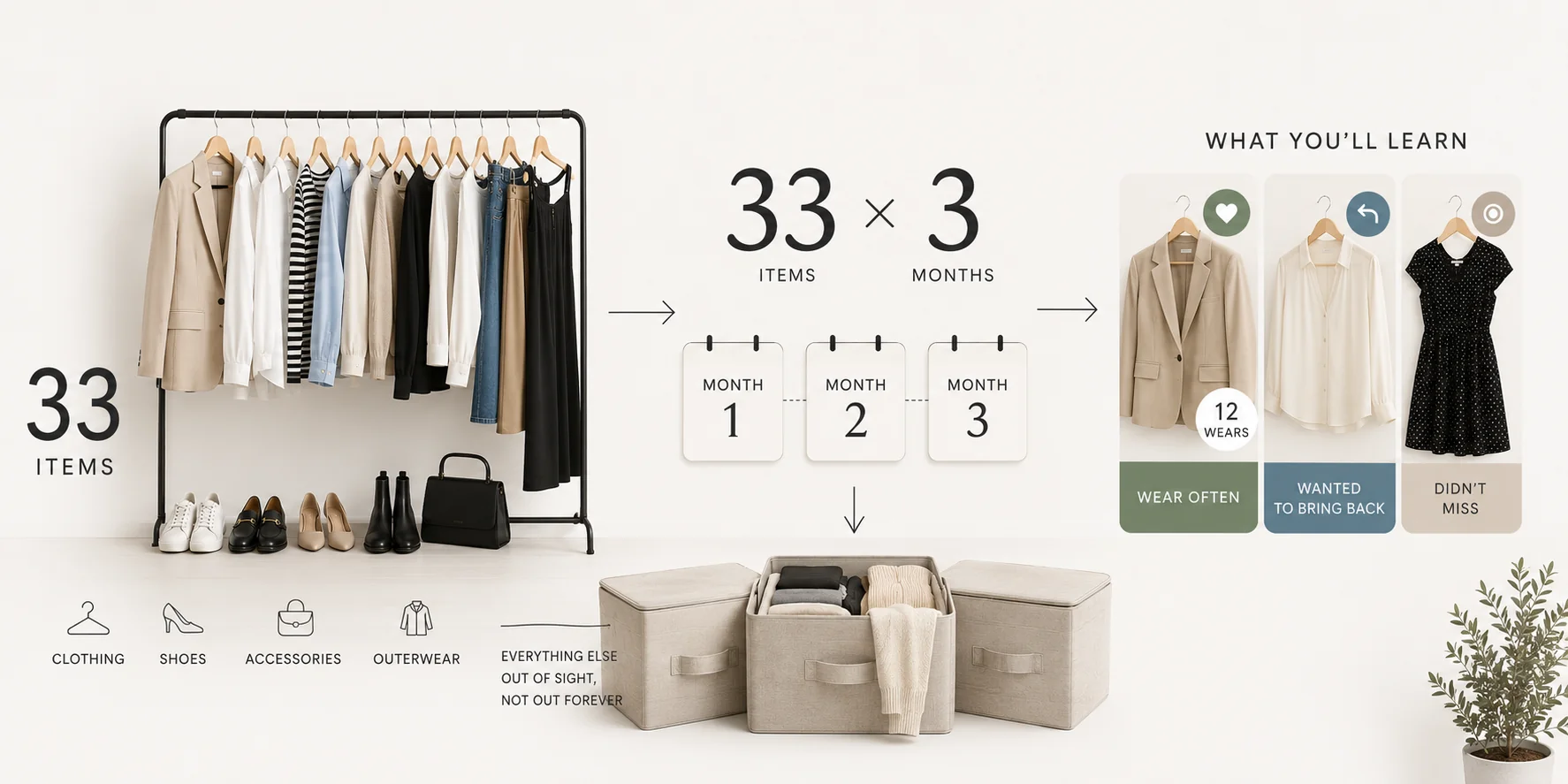
The count includes clothes, shoes, accessories, and outerwear. Underwear, sleepwear and at-home loungewear, and clothes you only use for working out, don't count. Everything else goes out of sight but not into the trash, which keeps the experiment fully reversible (the Project 333 rules).
That reversibility is what makes the method easy to try: you are not promising to become a minimalist forever, you are testing a hypothesis. Will 33 items be enough? What will I truly miss? Which pieces will prove irreplaceable? And which ones did I consider essential but never once wanted back?
During the experiment, it helps to log your outfits and track wears. At the end of three months, what matters isn't whether you "made it," but what you learned about your own habits.
How the app helps you do Project 333
You don't have to keep count by hand — the experiment is easy to run right in the app.
- Keep only your 33 chosen items in your active wardrobe and move the rest to the archive (the archive is a Premium feature) — so your closet stays reversible for the experiment.
- For three months, just log what you wear in the app.
- At the end, open your wardrobe statistics — no manual analysis needed: the app shows what you wore most, what you barely reached for, and other insights about your habits.
Your wardrobe doesn't fit your lifestyle? — organize it by occasion
Picture a wardrobe full of dressy outfits: cocktail dresses, blazers, heels. Now picture the actual week: remote work, walks, errands, a workout or two, one dinner with friends.
The problem here isn't the amount of clothing. Your wardrobe may simply reflect a lifestyle you no longer have.
Try roughly sorting your clothes by occasion:
- work;
- everyday;
- sport;
- events and going out;
- travel;
- other regular scenarios.
Then compare that with how your week actually goes.
You don't need a perfect mathematical match. But big mismatches show up fast.
If events take up a small slice of your life while event clothes take up a third of your closet, that alone can create the feeling of "so many clothes, nothing to wear."
In a digital wardrobe, filters and analytics let you view your clothes by occasion and spot these imbalances without counting by hand.
It's worth repeating this audit after any big change: a new job, a move, a different climate, a new sport, or simply a new routine. A wardrobe can be perfectly organized for the life you had three years ago and work poorly today.
Buying more than you need? — judge an item by how many times you'll wear it, not its price
A low price or a discount easily creates the feeling of a good deal. But a €20 item you've never worn doesn't become a good buy just because it was cheap.
Before buying, it helps to ask yourself not only "how much does this cost?" but also "how many times will I actually wear it?" With what? Where would I wear it? How often? Do I already own something similar?
That's the idea behind cost per wear: an item's price divided by the number of times you've worn it. For example, a €30 dress worn once ends up costing more per wear than a €60 T-shirt you've worn forty times.
A similar logic drives the #30Wears rule, popularized by Livia Firth: before buying, ask yourself whether you can picture wearing the item at least 30 times (about #30Wears). The number 30 isn't a scientific threshold or a mandatory quota. It's more a way to imagine the item outside the fitting room and in your real life, and check: do you really need it, and is there room for it in your wardrobe?
After the purchase, you no longer have to predict anything — you can look at your real wear history.
A high cost per wear doesn't by itself mean the purchase was a mistake. It can mean that:
- the item is new and it's too early to judge;
- it's a rarely worn but genuinely needed piece;
- you expected to wear it often but rarely reach for it — and it's worth understanding why.
The numbers don't decide for you. They help you spot the purchases and items worth a closer look.
Tired of choosing what to wear? — find your outfit formula
An organized wardrobe doesn't have to be a small one. Sometimes it's enough to stop inventing a new outfit every morning.
Look for a few combinations you reliably feel good in. For example: straight jeans + T-shirt + blazer + sneakers, or wide trousers + fine knit + loafers, or a midi dress + cropped jacket + boots.
That is an outfit formula.
If the same structure works for you most days, it can become a kind of personal uniform. That doesn't have to mean ten identical shirts: you can repeat the principle while changing the pieces. Art director Matilda Kahl famously wore the same formula to work for years, a white shirt with black trousers (Matilda Kahl's story).
Save a few outfits you already know work for you and return to them on days when you don't feel like deciding.
To keep things from getting monotonous, change one detail at a time: shoes, a color, an accessory, or the outer layer.
Losing track of your own wardrobe? — make it easier to see
Sometimes the problem isn't the amount of clothing or how it goes together. It's simply hard to hold your whole wardrobe in your head at once — especially when clothes are spread across different shelves, drawers, or stored away for another season.
A simple system helps: keep items by category — trousers with trousers, shirts with shirts. Within a category you can arrange them by color if that's easier for you, and store off-season pieces separately.
The point isn't for the closet to look perfect, but for you to quickly see what you already own.
A digital wardrobe gives a far clearer overview of everything you own: you can see it all together on one screen or filter by category, color, season, and other criteria.
This is especially handy before shopping. Before looking for a new white shirt or top, you can quickly check how many similar items you already own.
Don't pick one method forever
Different methods answer different questions. KonMari: what should I keep? A capsule: what goes with what? Project 333: how much is enough? Organizing by occasion: does my closet match my life? Cost per wear: which purchases actually work? Outfit formulas: how do I think less in the morning?
That's why the methods combine so well. For example:
- Clean out the closet and set aside what you clearly no longer need.
- Organize what's left by category.
- Pick a seasonal core and test it with outfits.
- Track what you actually wear for a few weeks.
- Use the results the next time you shop.
What you get isn't a "perfect wardrobe" built in one weekend. It's a system that keeps adjusting to your real life.
Where to start today
You don't have to empty the whole closet onto the bed.
Start with the one category that annoys you most. Trousers, for example. Gather them physically, or open the category in your digital wardrobe, and mentally split them into four groups:
- wear all the time;
- wear sometimes;
- haven't worn in ages, but I know why I keep them;
- haven't worn in ages, and I have no idea why I keep them.
Don't decide anything yet. Just look at what you have in front of you. Which types of items do you have the most of? Which shapes repeat? Are there duplicates? What do you keep buying again and again? What did you consider a favorite but haven't picked in months?
Even one category can reveal what kind of problem you're dealing with, and which method may help. Not because there is a correct number of clothes, but because you can finally see what's actually going on in your wardrobe.
What to do with clothes you no longer want to keep
Once you've decided an item is no longer needed, it's better to settle right away what to do with it, so it doesn't sit in a separate bag for another few months.
Items in good condition can be sold, given to friends, donated to a charity, or brought to a clothing swap. Just keep in mind that donating doesn't by itself guarantee an item a second life: some donated clothing never finds a new owner (The Conscious Closet, Elizabeth L. Cline).
If you want to keep an item but it needs a small repair, taking it to a tailor may be enough: replacing a zipper, sewing on a button, or hemming an edge.
Heavily worn items can go to textile collection bins or clothing take-back programs, if there are any nearby. Recycling doesn't work for every fabric, so it's best reserved for items that can no longer be worn.
If you set clothes aside "to sell," it helps to give yourself a deadline in advance: for example, if an item hasn't sold in a month, decide whether to keep storing it or give it away.
FAQ
Where do I start decluttering my wardrobe? Start by naming your main problem. If the closet is overstuffed, start with a clean-out. If pieces don't go together, start with a small capsule. If you forget what you own, start with sorting by category or digitizing. If the problem is shopping, start with wear tracking and cost per wear.
Can I combine several decluttering methods? Yes. They solve different problems. For example, clean out your closet first, then build a seasonal capsule, keep items sorted by category, and use the 30 wears rule before your next purchase.
How many items should a capsule wardrobe have? There is no fixed number. Popular seasonal versions often use around 30 to 40 pieces, but a good capsule is defined by how well the items work together and how well they fit your real life, not by a count.
What should I do with clothes I don't wear but can't let go of? Move them out of your main closet space for one season. If you need an item, you can always bring it back. This quarantine lets you test whether you need something without making a permanent decision.
Do I have to get rid of everything I haven't worn in a while? No. A rarely worn item is not automatically clutter. An evening dress, seasonal gear, or clothes for a specific activity can be worn rarely and still be needed. A low wear count is a reason to ask a question, not an automatic verdict.
Need help?
Contact us at support@getwardrobe.com